By Craig Alexander December 23, 2025
Pet grooming is now much more than just the occasional bath and trim. Today’s pet owners view grooming as a vital component of their animals’ ongoing comfort, well-being, and hygiene. Groomers are re-evaluating how they organize their services and earnings as customer expectations rise.
Uneven schedules, erratic income, and administrative stress are all caused by one-time appointments. Conversely, prepaid plans and recurring memberships provide stability for both the client and the company. Recurring pricing models help groomers reduce last-minute cancellations, increase client retention, and manage cash flow.
Memberships offer pet owners priority access, cost predictability, and convenience. Creating pricing models that make sense for various customer needs and billing them in a way that feels natural rather than intrusive is the challenge, not providing memberships. When pricing and billing are aligned thoughtfully, recurring models become a growth engine rather than an operational headache.
Understanding the Grooming Customer’s Mindset
It is crucial to understand how grooming clients think before creating any membership or package. The majority of pet owners do not compare grooming services in the same manner as they do retail goods.
They are considering routine, trust, and their pet’s comfort. When a client finds a groomer they can trust, they prefer consistency over variety. Grooming is particularly well-suited for recurring pricing because of this mindset. Every four weeks, every six weeks, or every two months, pet owners already follow schedules.
Memberships that follow these organic cycles feel more intuitive than sales-oriented. Adoption rates naturally rise when pricing models reflect consumer behavior. The most prosperous groomers portray memberships as a natural progression of responsible pet care rather than aggressively “selling” them.
Monthly Grooming Memberships as a Core Model
For many grooming businesses, monthly memberships are the main source of recurring income. For a fixed monthly cost, these plans usually include a predetermined number of grooms or maintenance services. Simplicity is appealing. Groomers are aware of what to anticipate, and customers are aware of what they will pay.
Aligning value with frequency is the key to successfully pricing monthly memberships. A strategy for high-maintenance breeds should acknowledge the effort required without coming across as harsh.
On the other hand, easier plans for low-maintenance or short-haired pets should seem doable. The objective is to reward consistency rather than offer significant discounts. Price sensitivity dramatically declines when consumers believe they are receiving priority scheduling, predictable prices, and peace of mind.
Multi-Visit Packages for Flexible Clients
Not every client desires a rigid monthly commitment. Some pet owners prefer seasonal grooming, alternate caregivers, or travel frequently. Prepaid multi-visit packages lock in revenue up front while providing flexibility. A predetermined number of grooms that are valid for several months may be included in packages. For clients who groom every six to eight weeks, this model is particularly effective.
Without compromising standard service rates, the pricing should offer a small incentive for prepayment. When packages are perceived as a convenience rather than a risk, they are successful. Confusion and disagreements later on are avoided with clear expiration dates, easy redemption guidelines, and transparent terms.
Tiered Memberships for Different Pet Needs
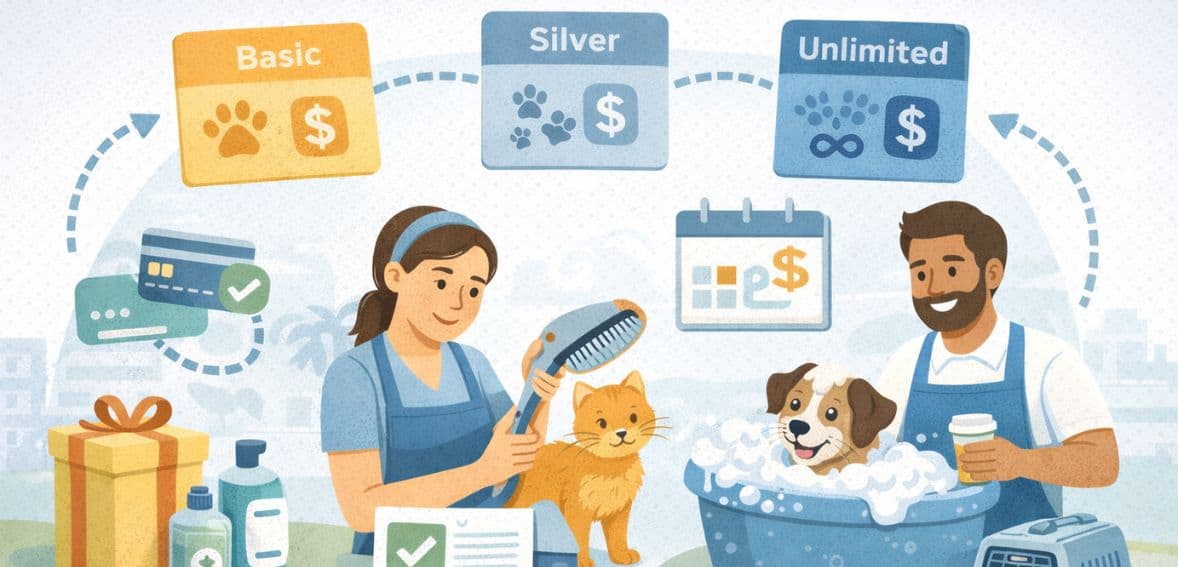
Tiered memberships are one of the best ways to increase recurring revenue. Not every pet owner has the same expectations, and not every pet needs the same amount of care. Groomers can serve a larger clientele without sacrificing service quality thanks to tiered pricing. Maintenance services like baths, nail trims, and brushing may be the focus of lower tiers.
Add-on services, specialty treatments, and full grooms are examples of higher tiers. The most important thing is clarity. Every tier ought to feel intentional rather than random. Consumers should be able to quickly determine which tier best suits their pet’s requirements. Upselling feels organic rather than forced when tiers are carefully planned.
Add-On Packages That Increase Lifetime Value

Add-on packages can greatly raise average customer value beyond basic grooming services. These could be spa upgrades, dental care, de-shedding services, or seasonal treatments. Add-ons don’t feel like impulsive purchases when they are part of a regular plan. Combining accessories in a way that corresponds with pet health cycles is the best strategy.
For example, paw care in the winter or shedding treatments during seasonal coat changes. Customers view add-ons as proactive care rather than optional extras when they feel timely and pertinent. These packages strengthen client relationships over time and set your company apart from rivals that only provide basic grooming services.
Pricing Without Undercutting Your Value
Over-discounting is a common error made by groomers when promoting memberships. The goal of recurring pricing is to provide convenience and consistency rather than lower grooming costs.
Deep discounts have the potential to backfire by drawing in price-conscious customers who rapidly leave. Rather, the operational advantages that memberships offer should be reflected in pricing. Hidden expenses are decreased by fewer no-shows, more efficient scheduling, and a steady workload.
While providing customers with non-monetary benefits like priority booking, reduced wait times, or exclusive service windows, membership pricing should safeguard margins. Customers are more inclined to make long-term commitments when pricing is defined around dependability rather than just savings.
The Importance of Clear Billing Structures
If billing seems unclear or inconsistent, even the strongest membership model will fail. Simplicity is important to grooming clients. They don’t want to keep track of bills, remember deadlines, or contest charges. Customer trust depends on seamless billing. Automatic, predictable, and transparent recurring billing is ideal.
Clients must be aware of the precise time and scope of charges. Friction is decreased with clear receipts, regular billing cycles, and early reminders. Memberships blend into the background of the customer experience when billing is smooth, which is precisely where they belong.
Card-on-File Billing Done Right
The basis for seamless recurring payments is card-on-file billing. But it needs to be treated carefully. When expectations are explicit and trust is built, customers are willing to store payment information. Easy access to payment history, explicit consent, and unambiguous cancellation conditions are non-negotiable.
The top grooming companies handle billing as a component of client support. They offer digital confirmations, promptly address inquiries, and explain how costs operate during registration. Customer retention rises, and conflicts decline when consumers feel informed rather than shocked. Beyond card-on-file billing, many salons also benefit from contactless payments, which speed up checkout, reduce friction, and enhance overall customer convenience.
Handling Pauses, Skips, and Life Changes

The lives of pet owners are rarely entirely predictable. Pet care demands can change due to illness, travel, or other circumstances. Resentment arises from rigid affiliations that prohibit flexibility. Careful pause or skip policies preserve connections without compromising profits. Effective groomers lay out these guidelines in detail up front.
Fairness is maintained through annual pauses, requirements for advance notice, or automatic extensions. Flexibility is systematic accommodation, not anarchy. Customers are much more inclined to stick around in the long run when they feel supported throughout disruptions.
Reducing No-Shows Through Membership Accountability
Increased attendance is one underappreciated advantage of recurring memberships. Customers are more likely to keep appointments when they pay in advance or receive automatic billing. Last-minute cancellations and no-shows are decreased by this psychological commitment.
This conduct is reinforced by explicit policies. While rescheduling within a predetermined timeframe maintains value, unannounced missed appointments may be considered used services. These guidelines should be conveyed in a composed and regular manner. When accountability feels reciprocal rather than punishing, memberships function best.
Digital Tools That Simplify Membership Management
Digital management solutions are quite beneficial to modern grooming firms. It is possible to centralize scheduling, billing, reminders, and reporting. The administrative workload significantly decreases when systems communicate with each other. Integration, not complexity, is the aim.
Booking, managing memberships, and viewing payment history should all be simple for customers. Employees should devote more time to providing high-quality treatment and less time to account reconciliation.
Memberships can be scaled without adding burden because of well-implemented technologies. Centralizing scheduling, billing, reminders, and reporting becomes even easier with reliable pet grooming software, helping salons manage recurring memberships and customer data without manual headaches.
Training Staff to Present Memberships Naturally
It should never be difficult to sell memberships. Groomers and front desk employees should offer them as choices rather than requirements. Training is essential. Employees should know which plans benefit whom and how to articulate value.
Customers trust recommendations made by employees who speak with assurance and sincerity. Membership discussions are most effective when they center on routine care and pet well-being rather than price comparisons. This strategy improves relationships and naturally boosts adoption.
Managing Membership Expirations and Renewals Gracefully

A crucial point in the client relationship is when a membership expires. They come across as abrupt or transactional when handled poorly. They feel like a logical extension of care when properly managed. Instead of viewing renewals as billing events, groomers should view them as service touchpoints.
Friction is decreased by early reminders, concise benefit explanations, and simple renewal procedures. When customers see the value they have already received, they are much more likely to renew. Automatic renewals further stabilize revenue without undermining confidence when combined with explicit authorization and simple opt-out choices.
The intention is to make renewal feel beneficial and expected rather than forced. In addition to maintaining long-term client engagement without continual reselling, a smooth renewal process upholds professionalism.
Measuring Success Beyond Monthly Revenue
Recurring revenue is crucial, but it shouldn’t be the sole indicator. Effective membership programs also increase customer satisfaction, scheduling effectiveness, and retention. A more comprehensive view can be obtained by monitoring churn rates, average visits per client, and no-show decreases.
These operational enhancements frequently have a greater long-term impact than immediate revenue increases. A steady, devoted customer base lowers marketing expenses and promotes long-term expansion. Memberships represent an evolution of the company model, not only a pricing scheme.
Avoiding Common Membership Pitfalls
After early difficulties, some groomers give up on their memberships. Unclear terms, uneven enforcement, and inadequate communication are typical issues. With careful planning and discipline, these problems can be prevented.
Memberships need to be structured. Regular reviews, uniform policies, and clear documentation keep minor problems from growing into systemic ones. When difficulties occur, resolving them openly increases credibility rather than undermining trust.
Using Membership Data to Improve Service Quality

Recurring memberships generate valuable behavioural data that can improve service delivery. Patterns in appointment frequency, service usage, add-on preferences, and rescheduling behavior reveal what customers truly value.
Groomers who analyze this data can refine service offerings, adjust staffing levels, and personalize recommendations. For example, identifying members who frequently skip appointments may signal schedule misalignment rather than disinterest. Data also helps identify opportunities for proactive care, such as recommending coat treatments before seasonal shedding peaks.
When data informs service decisions, memberships become more than revenue tools—they become insight engines. Used thoughtfully, this information improves customer experience, operational efficiency, and long-term loyalty without feeling invasive.
The Long-Term Impact of Recurring Models
Recurring subscriptions change grooming companies over time. Client relationships strengthen, scheduling becomes predictable, and cash flow stabilizes. Owners spend more time enhancing services and less time pursuing payments. The most significant benefit of recurring models is that they lessen burnout.
Both employees and owners gain from predictability. Teams work better and stay longer when expectations are clear, and workloads are matched. Everyone involved benefits from a healthy business ecosystem because of memberships.
Conclusion: Designing Memberships That Truly Work
The goal of recurring memberships and packages is not to force customers to make commitments. They are about matching business practices to the attitudes and actions of pet owners.
Memberships feel organic, helpful, and worthwhile when pricing models accurately reflect actual demands and payment is managed with ease. Recurring model groomers that are successful concentrate on trust, adaptability, and clarity.
They invest in friction-reducing solutions, communicate honestly, and set reasonable prices. Stronger relationships and a more robust company are the outcomes, in addition to more consistent revenue. Recurring memberships are a logical next step in an industry that is based on care and consistency, not a trend.
FAQs
In what ways do grooming memberships lower customer churn?
They create predictable engagement and stronger loyalty when memberships align with regular pet care routines and customer expectations.
Should memberships be heavily discounted to attract new members?
No. Value should come from convenience, priority access, and consistency rather than deep price reductions.
How often should membership pricing be reviewed?
At least once a year, taking into account changes in services offered, labor costs, and customer demand.
What causes most grooming membership billing disputes?
Most disputes stem from poor billing communication, unclear consent, and inconsistent policies rather than pricing issues.
Can small grooming businesses manage memberships without hiring more staff?
Yes. With clear policies and automated billing and scheduling systems, small teams can manage memberships efficiently.